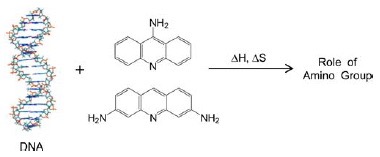
Effect of Number and Location of Amine Groups on the Thermodynamic Parameters on the Acridine Derivatives to DNA 


Vol. 34,  No. 3, pp. 810-814, Mar.  2013
10.5012/bkcs.2013.34.3.810


PDF
  Tumbnail

  Abstract

The thermodynamic parameters for the intercalative interaction of structurally related well known intercalators, 9-aminoacridine (9AA) and proflavine (PF) were determined by means of fluorescence quenching study. The fluorescence intensity of 9AA decreased upon intercalation to DNA, poly[d(A-T)2] and poly[d(G-C)2]. A van’t Hoff plot was constructed from the temperature-dependence of slope of the ratio of the fluorophore in the absence and presence of a quencher molecule with respect to the quencher concentration, which is known as a Stern-Volmer plot. Consequently, the thermodynamic parameters, enthalpy and entropy change, for complex formation was calculated from the slope and y-intercept of the van’t Hoff plot. The detailed thermodynamic profile has been elucidated the exothermic nature of complex formation. The complex formation of 9AA with DNA, poly[d(A-T)2] and poly[d(G-C)2] was energetically favorable with a similar negative Gibb’s free energy. On the other hand, the entropy change appeared to be unfavorable for 9AA-poly[d(G-C)2] complex formation, which was in contrast to that observed with native DNA and poly[d(A-T)2] cases. The equilibrium constant for the intercalation of PF to poly[d(G-C)2] was larger than that to DNA, and was the largest among sets tested despite the most unfavorable entropy change, which was compensated for by the largest favorable enthalpy. The favorable hydrogen bond contribution to the formation of the complexes was revealed from the analyzed thermodynamic data.

  Statistics
Cumulative Counts from November, 2022
Multiple requests among the same browser session are counted as one view. If you mouse over a chart, the values of data points will be shown.


  Cite this article

[IEEE Style]

J. H. Kwon, H. Park, N. Chitrapriya, S. W. Han, G. J. Lee, D. J. Lee, T. Cho, "Effect of Number and Location of Amine Groups on the Thermodynamic Parameters on the Acridine Derivatives to DNA," Bulletin of the Korean Chemical Society, vol. 34, no. 3, pp. 810-814, 2013. DOI: 10.5012/bkcs.2013.34.3.810.

[ACM Style]

Ji Hye Kwon, Hee-Jin Park, Nataraj Chitrapriya, Sung Wook Han, Gil Jun Lee, Dong Jin Lee, and Tae-Sub Cho. 2013. Effect of Number and Location of Amine Groups on the Thermodynamic Parameters on the Acridine Derivatives to DNA. Bulletin of the Korean Chemical Society, 34, 3, (2013), 810-814. DOI: 10.5012/bkcs.2013.34.3.810.