
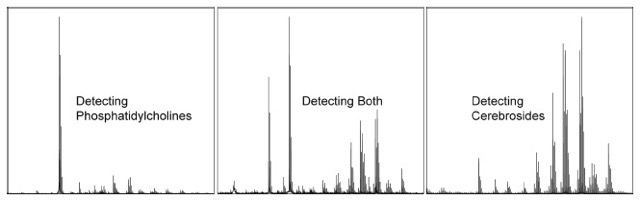
Selective or Class-wide Mass Fingerprinting of Phosphatidylcholines and Cerebrosides from Lipid Mixtures by MALDI Mass Spectrometry
Vol. 34, No. 7, pp. 2143-2147, Jul. 2013
 10.5012/bkcs.2013.34.7.2143
Tumbnail
Abstract
Statistics
Cumulative Counts from November, 2022
Multiple requests among the same browser session are counted as one view. If you mouse over a chart, the values of data points will be shown.
Multiple requests among the same browser session are counted as one view. If you mouse over a chart, the values of data points will be shown.
|
|
Cite this article
[IEEE Style]
G. Lee, J. Son, S. Cha, "Selective or Class-wide Mass Fingerprinting of Phosphatidylcholines and Cerebrosides from Lipid Mixtures by MALDI Mass Spectrometry," Bulletin of the Korean Chemical Society, vol. 34, no. 7, pp. 2143-2147, 2013. DOI: 10.5012/bkcs.2013.34.7.2143.
[ACM Style]
Gwangbin Lee, Jeongjin Son, and Sangwon Cha. 2013. Selective or Class-wide Mass Fingerprinting of Phosphatidylcholines and Cerebrosides from Lipid Mixtures by MALDI Mass Spectrometry. Bulletin of the Korean Chemical Society, 34, 7, (2013), 2143-2147. DOI: 10.5012/bkcs.2013.34.7.2143.
ISSN(Print) 0253-2964
ISSN(Online) 1229-5949
