
Synthesis and Crystal Structures of Copper(II) Complexes with Schiff Base Ligands: [Cu2(acpy-mdtc)2(HBA)(ClO4)]·H2O and [Cu2(acpy-phtsc)2(HBA)]·ClO4
Vol. 34, No. 11, pp. 3233-3238, Nov. 2013
 10.5012/bkcs.2013.34.11.3233
Tumbnail
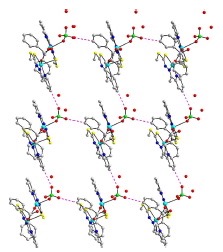
Abstract
Statistics
Cumulative Counts from November, 2022
Multiple requests among the same browser session are counted as one view. If you mouse over a chart, the values of data points will be shown.
Multiple requests among the same browser session are counted as one view. If you mouse over a chart, the values of data points will be shown.
|
|
Cite this article
[IEEE Style]
B. K. Koo, "Synthesis and Crystal Structures of Copper(II) Complexes with Schiff Base Ligands: [Cu2(acpy-mdtc)2(HBA)(ClO4)]·H2O and [Cu2(acpy-phtsc)2(HBA)]·ClO4," Bulletin of the Korean Chemical Society, vol. 34, no. 11, pp. 3233-3238, 2013. DOI: 10.5012/bkcs.2013.34.11.3233.
[ACM Style]
Bon Kweon Koo. 2013. Synthesis and Crystal Structures of Copper(II) Complexes with Schiff Base Ligands: [Cu2(acpy-mdtc)2(HBA)(ClO4)]·H2O and [Cu2(acpy-phtsc)2(HBA)]·ClO4. Bulletin of the Korean Chemical Society, 34, 11, (2013), 3233-3238. DOI: 10.5012/bkcs.2013.34.11.3233.
ISSN(Print) 0253-2964
ISSN(Online) 1229-5949
