A Multisegmented Polystyrene with pH-Cleavable Linkages 


Vol. 35,  No. 9, pp. 2694-2698, Sep.  2014
10.5012/bkcs.2014.35.9.2694


PDF
  Tumbnail

  Abstract

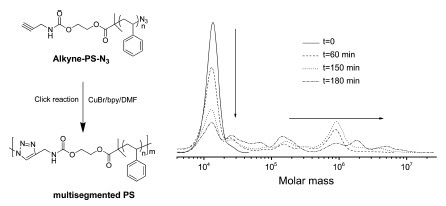
A multisegmented polystyrene (PS) with pH-cleavable ester and carbamate linkages was successfully synthesized by a combination of atom transfer radical polymerization (ATRP) and Cu(I)-catalyzed 1,3-dipolar cycloaddition of azide and alkynes (click chemistry). ATRP was employed to synthesize polystyrene from hydroxyl-terminated initiator using CuBr/N,N,N',N'',N''-pentamethyldiethylenetriamine (PMDETA) as the catalyst. The reaction of the resulting PS with sodium azide yielded the azido-terminated polymer. The hydroxyl group in the other end of the polymer was reacted with 4-nitrophenyl chloroformate (NPC), followed by reaction with propargylamine to produce an alkyne end group with a carbamate linkage. The PS with an alkyne group in one end and an azide group in the other end was then self-coupled in the presence of CuBr/2,2'- bipyridyl (bpy) in DMF to yield a desired multisegmented PS. Molecular weight and molecular weight distribution of the self-coupled polymer increased with time, as in the typical step-growth-type polymerization processes. Finally, we demonstrated that the ester and carbamate linkages of the multisegmented PS were hydrolyzed in the presence of HCl to yield individual PS chains.

  Statistics
Cumulative Counts from November, 2022
Multiple requests among the same browser session are counted as one view. If you mouse over a chart, the values of data points will be shown.


  Cite this article

[IEEE Style]

T. Kang and H. Lee, "A Multisegmented Polystyrene with pH-Cleavable Linkages," Bulletin of the Korean Chemical Society, vol. 35, no. 9, pp. 2694-2698, 2014. DOI: 10.5012/bkcs.2014.35.9.2694.

[ACM Style]

Tae-Hyeon Kang and Hyung-il Lee. 2014. A Multisegmented Polystyrene with pH-Cleavable Linkages. Bulletin of the Korean Chemical Society, 35, 9, (2014), 2694-2698. DOI: 10.5012/bkcs.2014.35.9.2694.